
 Mon - Fri : 9AM - 5PM
How to Stop Overthinking: 9 Techniques to Quiet a Racing Mind
You replay a conversation from three days ago. You draft the same email six times. You lie down at 11 p.m. and your brain finally decides it’s time to review every decision you’ve made since 2019.
If that sounds familiar, you already know that “just stop thinking about it” is useless advice. Learning how to stop overthinking isn’t about switching your mind off, that’s not something a human brain does on command. It’s about interrupting the loop your mind is stuck in and giving it somewhere else to go.
Below are nine techniques that do exactly that. Some take thirty seconds. Some take a week of practice. All of them work on the same principle: an overthinking mind isn’t broken, it’s just running a pattern that nobody ever taught it to exit.
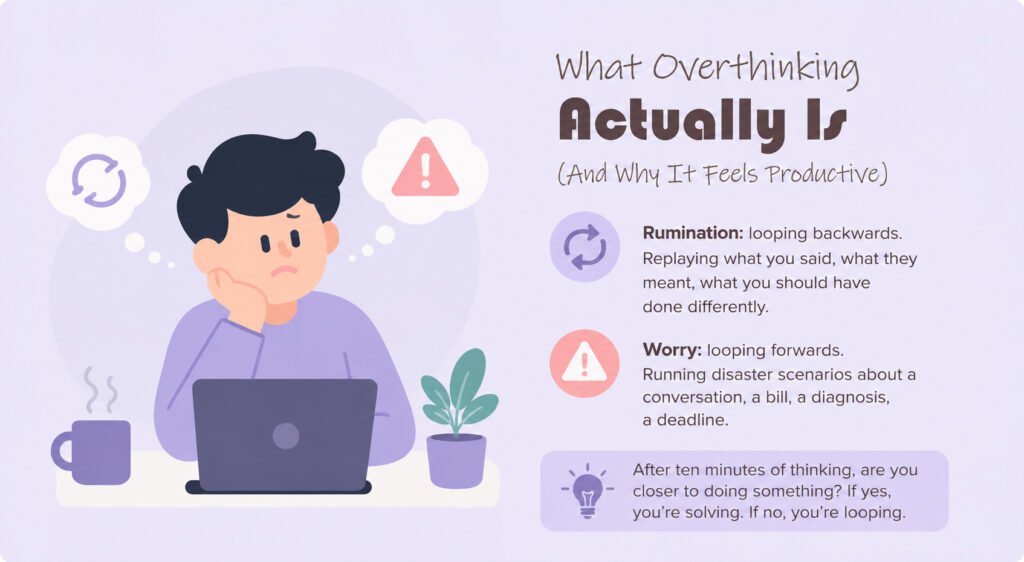
What Overthinking Actually Is (And Why It Feels Productive):
Overthinking usually shows up in one of two forms:
Rumination: looping backwards. Replaying what you said, what they meant, what you should have done differently.
Worry: looping forwards. Running disaster scenarios about a conversation, a bill, a diagnosis, a deadline.
Both feel like problem-solving. That’s the trap. Your brain registers the mental effort and assumes it’s making progress, so it keeps going. But real problem-solving produces a decision or an action. Overthinking produces another lap.
Here’s the simplest test: after ten minutes of thinking, are you closer to doing something? If yes, you’re solving. If you’re just more tense and no clearer, you’re looping.
Why Do You Overthink Everything?
Overthinking rarely comes out of nowhere. The most common drivers:
- Uncertainty. The mind treats an unresolved situation like an open browser tab and keeps refreshing it.
- Perfectionism. If every choice must be the best choice, no choice ever feels finished.
- A past experience that cost you. One bad decision teaches the brain that vigilance is safety.
- Fear of judgment. Rehearsing conversations is your mind trying to pre-approve you.
- Fatigue. A tired brain has less capacity to stop a thought once it starts. This is exactly why overthinking peaks at night.
Notice that none of these are character flaws. They’re a nervous system doing what it thinks is protective, just far past the point of usefulness.
9 Techniques to Stop Overthinking:
1. Name the loop out loud:
The moment you catch yourself spiraling, say it plainly: “I’m looping on the meeting.”
This sounds too small to matter. It isn’t. Naming a mental state shifts you from being inside the thought to observing it, and you cannot loop and observe at the same time. The thought stops being reality and becomes an event you’re watching.
Try the phrasing: “I’m having the thought that I handled that badly.” Not “I handled that badly.” The extra four words create the entire gap you need.
2. Ask: can I act on this in the next 24 hours?
Every worry sorts into one of two boxes.
Actionable: there is a step you can take. Then take the smallest version of it right now, send the text, open the document, write the one line. Action is the only thing that genuinely closes the tab.
Not actionable: the outcome depends on someone else, on time, or on information you don’t have. This is the category that eats people alive, because there’s nothing to do, so the mind substitutes thinking for action, forever.
For the second box, say to yourself: “There is no move available right now. I’ll revisit it Thursday.” Then physically write “Thursday” somewhere. You’re not suppressing the thought, you’re giving it an appointment, which is the only thing an anxious brain will accept instead of resolution.
3. Book a worry window:
Pick fifteen minutes at a fixed time each day, say 6:00 p.m. During that window, you’re allowed to worry as hard as you like. Write it all out.
Outside the window, when a worry shows up, you tell it: “6 o’clock.”
This feels almost silly for the first two days and then it starts working, for a specific reason: your brain repeats worries because it’s afraid you’ll forget them. Once it learns there’s a guaranteed slot where everything gets heard, the urgency drops. Most people find that by the time 6 p.m. arrives, half the list has already dissolved.
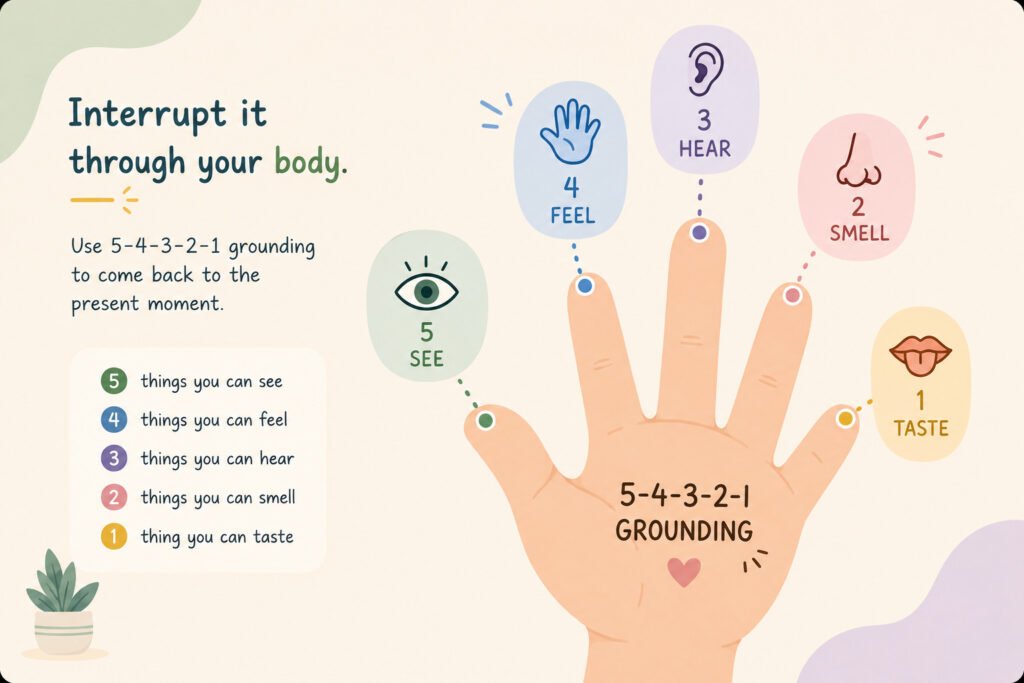
4. Interrupt it through your body, not your mind:
You cannot out-think a thought loop. You can absolutely out-move one.
- Cold water on your wrists or face triggers a fast physiological reset.
- Ten slow exhales, breathing out longer than you breathe in, the long exhale is the part that shifts your nervous system out of alert mode.
- The 5-4-3-2-1 scan: name five things you can see, four you can feel, three you can hear, two you can smell, one you can taste.
- Two minutes of movement, stairs, a walk to the end of the street, anything.
The point isn’t relaxation. It’s that these all demand present-moment attention, and the present moment is the one place overthinking cannot exist. Overthinking lives entirely in the past or the future.
5. Empty your head onto paper:
Set a timer for ten minutes and write every thought down without editing, punctuating, or organizing. Bullet points, fragments, contradictions, all fine.
Two things happen. First, thoughts that felt enormous and tangled turn out to be about four concerns wearing trench coats. Second, your working memory gets to let go of them, because they’re now stored somewhere that isn’t your head.
At the end, circle anything actionable and ignore the rest. That circled list is usually much shorter than the fear suggested.
6. Give the decision a deadline and a “good enough” bar:
Overthinkers rarely lack answers. They lack permission to stop looking for a better one.
Before you start deliberating, decide two things in advance: when you’ll decide, and what “good enough” looks like. For example: “By Friday, I’ll pick the option that meets these three criteria.”
Then, when Friday comes, choose, even if you’re only 80% sure. Most decisions are far more reversible than they feel at the time, and the cost of two more weeks of deliberation is almost always higher than the cost of the second-best option.
7. Interrupt the loop with self-hypnosis:
Overthinking is, functionally, a groove, a well-worn track your mind slides into automatically. You can talk yourself out of a groove all day at the conscious level, but the pattern lives below that, which is why insight alone so rarely changes it.
Self-hypnosis works at that lower level. In a relaxed, focused state, the mind becomes far more responsive to a new instruction than it is in ordinary alert awareness, which is why the same technique is used for breaking bad habits and improving sleep.
A short version you can do tonight:
- Sit somewhere you won’t be disturbed. Let your eyes close.
- Count down slowly from ten to one, letting your shoulders drop a little on each number.
- Picture the thought loop as something with a physical form, a spinning wheel, a tape, a treadmill.
- See yourself slowing it, then stopping it. Not fighting it. Slowing it.
- Repeat quietly: “I notice the thought. I let it pass. I return to now.”
- Count up from one to five and open your eyes.
Five minutes, once a day. The value isn’t in any single session, it’s that you’re training an exit route, so that eventually the loop starts ending on its own. There’s a fuller walkthrough in the guide to self-hypnosis.
8. Cut the input feeding it:
Overthinking needs fuel. Common sources: doomscrolling before bed, checking a message thread for the fourteenth time, researching a symptom at 1 a.m., or a particular person whose opinion you keep mentally auditioning for.
For one week, remove the biggest single source. Not all of them, one. Phone out of the bedroom is usually the highest-yield change anyone can make.
You’ll notice quickly how much of what felt like your anxiety was actually just the last thing you looked at.
9. Do something that requires both hands:
Cooking, gardening, an instrument, cleaning a room properly, a physical craft. Tasks that occupy your hands and eyes together leave very little bandwidth for a mental loop to run in the background.
This is why so many people report that their best thinking, and their calmest thinking, happens while doing something completely unrelated. Overthinking needs an idle mind to run on. Take away the idle.
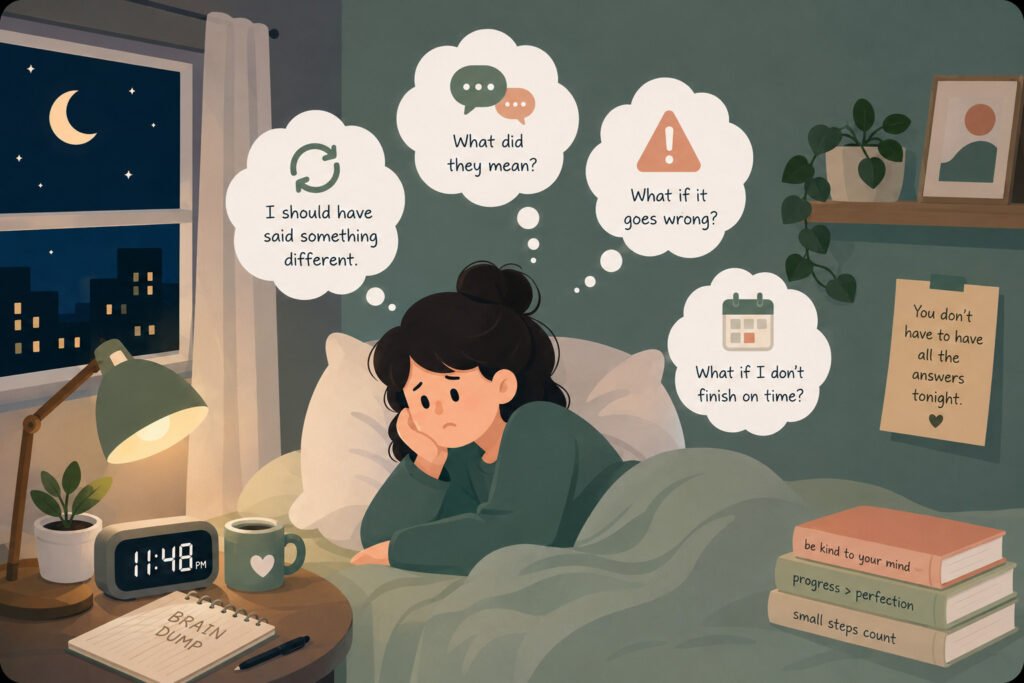
How to Stop Overthinking at Night?
Night is where overthinking does its worst work, and there’s a reason for it. There’s no task in front of you, no light, no distraction, and your prefrontal cortex, the part that regulates thoughts, is tired. Everything that felt manageable at 3 p.m. is unmanageable at midnight.
What helps:
- Do a brain dump before bed, not in bed. Ten minutes at the kitchen table, closing the loops while you’re still upright.
- Keep a notepad on the nightstand. If a thought arrives, write one line and put it down. You’re telling your brain “recorded”, which is what it wanted.
- Get out of bed after twenty minutes. Lying there teaches your brain that bed is where thinking happens. Go sit somewhere dim, do something boring, return when sleepy.
- Use a long exhale. In for four, out for eight, for two minutes. Sleep follows a downshifted nervous system, not a quiet mind.
- Decide nothing after 10 p.m. Late-night thinking feels urgent and lucid. It is neither. Whatever it is, it will still be there in the morning, at about 40% of the size.
When Overthinking Needs More Than Self-Help?
Self-help techniques are genuinely effective for most everyday overthinking. But please talk to a doctor or licensed mental health professional if:
- The thoughts are constant and you can’t work, sleep, or hold a conversation through them
- You’re experiencing panic attacks, or physical symptoms like chest tightness and shortness of breath
- The looping centres on trauma, intrusive images, or thoughts you find frightening
- It’s been going on for months and getting worse, not better
- You’re having any thoughts of harming yourself
Overthinking that has tipped into an anxiety disorder needs proper clinical support, and there is no prize for handling that alone.
How Hypnotherapy Helps With Overthinking?
Most people who overthink already understand their pattern perfectly. They can describe it, name the trigger, explain exactly why it isn’t rational, and still do it again the next day. That gap between knowing and changing is the whole problem, and it exists because the pattern isn’t stored at the level of logic.
Hypnotherapy works with that lower level directly. In a guided session, we identify what the loop is actually protecting you from, usually judgment, loss of control, or repeating an old mistake, and build a different automatic response to the moment it starts. Not forced positivity. A genuine exit.
Most clients are looking at somewhere between three and six sessions for meaningful change with overthinking, though it depends heavily on how long the pattern has been running.
If your mind has been running you rather than the other way around, book a free consultation and we’ll talk about what’s underneath it. Sessions are available in Greensboro, NC and online.
Frequently Asked Questions:
1- Why can’t I stop overthinking even when I know it’s irrational?
Because the pattern doesn’t live in the rational part of your mind. Insight and habit are stored differently, which is why understanding a loop doesn’t dissolve it. Changing it takes repetition of a new response, not more analysis of the old one.
2- Is overthinking the same as anxiety?
No, though they overlap heavily. Overthinking is a mental behaviour, the looping itself. Anxiety is a broader condition involving physical, emotional, and cognitive symptoms. Overthinking is often a symptom of anxiety, but plenty of people overthink without having an anxiety disorder.
3- How long does it take to stop overthinking?
Most people notice a difference within one to two weeks of consistent practice with one or two techniques. Lasting change usually takes a few months, because you’re replacing a pattern the mind has run for years.
4- Does overthinking get worse with age?
Not inherently. It tends to worsen with unresolved stress, poor sleep, and periods of high uncertainty, all of which can accumulate over time, but none of which are caused by age itself.
5- Can hypnosis really stop overthinking?
Hypnosis can be very effective at interrupting habitual thought patterns, because it works with the automatic level where those patterns are stored. It isn’t a single-session cure, and it isn’t a substitute for medical care where an anxiety disorder is present, but as a tool for changing an entrenched mental habit, it’s one of the more direct options available.
Important Note: This article is for informational purposes only and is not medical advice, diagnosis, or treatment. Cristy Flores is a certified hypnotist and coach, not a licensed medical or mental health provider. If you’re struggling with persistent anxiety or distressing thoughts, please consult a qualified healthcare professional.